United Kingdom
+44 (0) 1628 660600
hello@creative-computing.co.uk
hello@creative-computing.co.uk
E-invoicing has moved from a talking point to a confirmed direction of travel for UK tax policy. If you run a small or medium-sized business on Dynamics 365 Business Central, the question is no longer whether this affects you, but how much runway you have to prepare properly rather than scrambling later.
This isn't a call to panic. The timeline gives businesses years, not months, to adjust. But the businesses that get ahead of it will spend that time preparing calmly, and the ones that wait will spend it firefighting. Here's what e-invoicing actually involves, where UK policy currently stands, what's already changed inside Business Central, and what SMEs can practically do now.
It's worth being precise about this, because "e-invoicing" gets used loosely. E-invoicing is not simply emailing a PDF invoice instead of posting a paper one. A PDF is a picture of an invoice: a person still has to open it, read it, and key the figures into their own accounting system by hand.
True e-invoicing is the direct, structured invoice data exchange between the supplier's and buyer's financial systems, with no manual re-entry step in between. The invoice is issued in a machine-readable format that the receiving system can validate, process, and post automatically. This is what underpins networks like Peppol, the interoperability framework increasingly used across Europe (and now confirmed as the model the UK will build on) to let invoices move securely between different software platforms regardless of who supplies them.
The distinction matters because a lot of businesses already think of themselves as "doing e-invoicing" simply because they send invoices electronically. Under a genuine e-invoicing mandate, that won't be enough. The data itself needs to be structured and machine-readable at both ends.
In February 2025, HMRC and the Department for Business and Trade launched a joint consultation on promoting e-invoicing across UK businesses and the public sector. The consultation ran for twelve weeks and gathered views from businesses of all sizes on whether e-invoicing should be mandated, what scope any mandate should cover, and how it might integrate with wider digital tax reporting.
The government's own case for e-invoicing cites productivity benefits. A Sage-authored research report referenced in HMRC's press release put the potential productivity gain from e-invoicing adoption at around 3% annually for UK businesses, largely from reduced manual data entry and faster payment cycles. The same release noted that roughly 130 countries already have, or are actively building, e-invoicing frameworks, putting the UK's move in line with a broader international shift rather than ahead of it.
At the Autumn Budget in November 2025, the government confirmed the outcome: e-invoicing will become mandatory for all VAT invoices, covering both business-to-business and business-to-government transactions, from 1 April 2029. A full technical roadmap, including standards, formats and the detail of how the mandate will be phased in, is expected at Budget 2026. Businesses currently below the VAT registration threshold, and the exact scope of any phasing by business size, are among the details still to be finalised.
Note for readers: this is still evolving policy, and the detail confirmed at Budget 2026 may adjust elements of scope and timing. It's worth checking gov.uk directly for the latest position before making firm plans around specific dates.
It's also worth placing this within the UK's broader digital tax direction. Making Tax Digital already requires VAT-registered businesses to keep digital records and file VAT returns through compatible software. E-invoicing is a natural continuation of that same principle: fewer manual steps, less room for error, and data that HMRC and businesses can both trust.
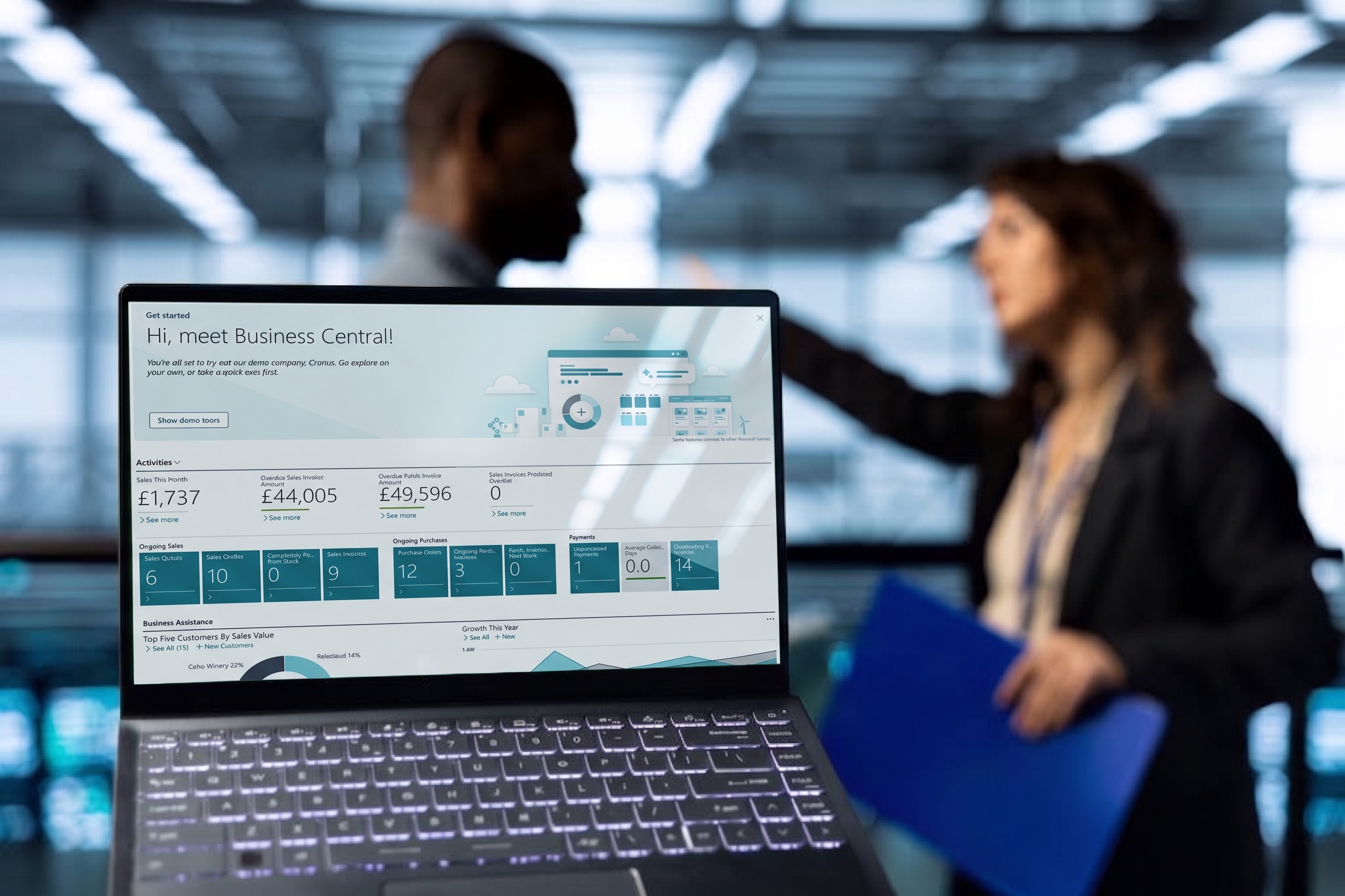
This is where the "before it becomes mandatory" part of the story gets more immediate. Dynamics 365 Business Central didn't wait for the UK mandate to start building e-invoicing capability. The 2026 Release Wave 1 update extended Business Central's e-documents framework, the underlying architecture that supports the structured, machine-readable exchange of invoices and other business documents between systems.
In practical terms, this means the foundation for e-invoicing readiness is already sitting inside many Business Central environments, whether or not it's switched on. For businesses running the platform, the choice isn't between "build this from scratch" and "wait." It's between "start using capability that's already there" and "leave it dormant until the mandate forces the issue."
This is a meaningful difference from businesses running older or more fragmented finance systems, who may be facing a genuine build-or-buy decision when the roadmap lands. Business Central users are, in a real sense, ahead of that curve already. The remaining work is largely about configuration, connectivity, and data quality rather than a platform overhaul. Typically the Continia apps are implemented for the sending and receiving processes, via the Peppol network.
None of the following requires waiting for Budget 2026 or the final mandate detail. They're worth doing regardless, because they improve day-to-day invoicing efficiency as well as e-invoicing readiness.
1. Enable the functionality in your current setup. If you're on a recent version of Business Central, check what e-document and e-invoicing capability is already available to you and whether it's switched on. This is a configuration conversation, not a development project, for most SMEs already on supported versions.
2. Talk to your key suppliers and customers. E-invoicing only works when both sides of a transaction can exchange structured data. Start with your highest-volume trading relationships. Ask whether they're already using or planning to adopt e-invoicing, and on which network or standard. Early conversations now mean you're not negotiating connectivity under time pressure later.
3. Clean up your master data. Structured invoice exchange depends on accurate, complete records at both ends: correct VAT numbers, current addresses, valid contact and billing details for every customer and vendor. Data that's "good enough" for a human to glance at and correct manually often isn't good enough for automated, structured exchange. A data cleanse now is far less disruptive than one done under mandate deadline pressure.
None of these steps commits you to a particular technical path before the UK roadmap is confirmed. They simply put you in a position to move quickly and calmly once it is, rather than starting from zero.
The direction of UK policy is now clear, even if some of the detail isn't. E-invoicing is coming, the government has said so plainly, and the businesses best placed for 2029 will be the ones who treated the years in between as preparation time rather than a countdown to worry about later.
For Business Central users specifically, that preparation is more advanced than it might feel. The platform's own roadmap has been moving in step with UK policy, and much of the underlying capability is already available. The gap between where most SMEs are today and where the mandate will eventually require them to be is smaller than the 2029 date makes it look.
If you want to understand exactly what e-invoicing capability exists inside your current Business Central setup, and what configuration, connectivity or data work would put you ahead of the mandate rather than behind it, get in touch with Creative Computing. We'll walk you through what's already available to you and what a sensible readiness plan looks like for your business.

.jpg)
.jpeg)
.png)

.jpg)
.png)
.png)